Donald Trump, the president convicted felon, and a Russian KGB asset “Krasnov” since 1987, according to reports from Yuri Borysovych Shvets and Alnur Aljapparuly Mussayev, has threatened and persecuted the following people, companies, and universities, among others.

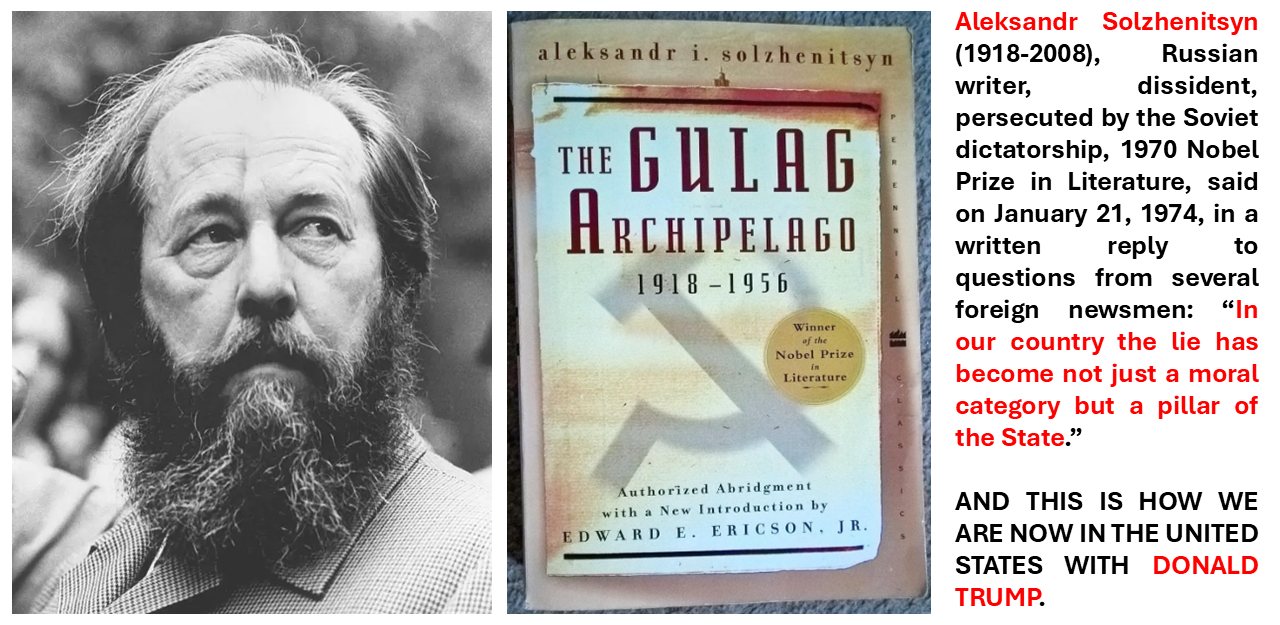
Aleksandr Solzhenitsyn (1918-2008), Russian writer, dissident, persecuted by the Soviet dictatorship, 1970 Nobel Prize in Literature, said on January 21, 1974, in a written reply to questions from several foreign newsmen: “In our country the lie has become not just a moral category but a pillar of the State.”
AND THIS IS HOW WE ARE NOW IN THE UNITED STATES WITH DONALD TRUMP.
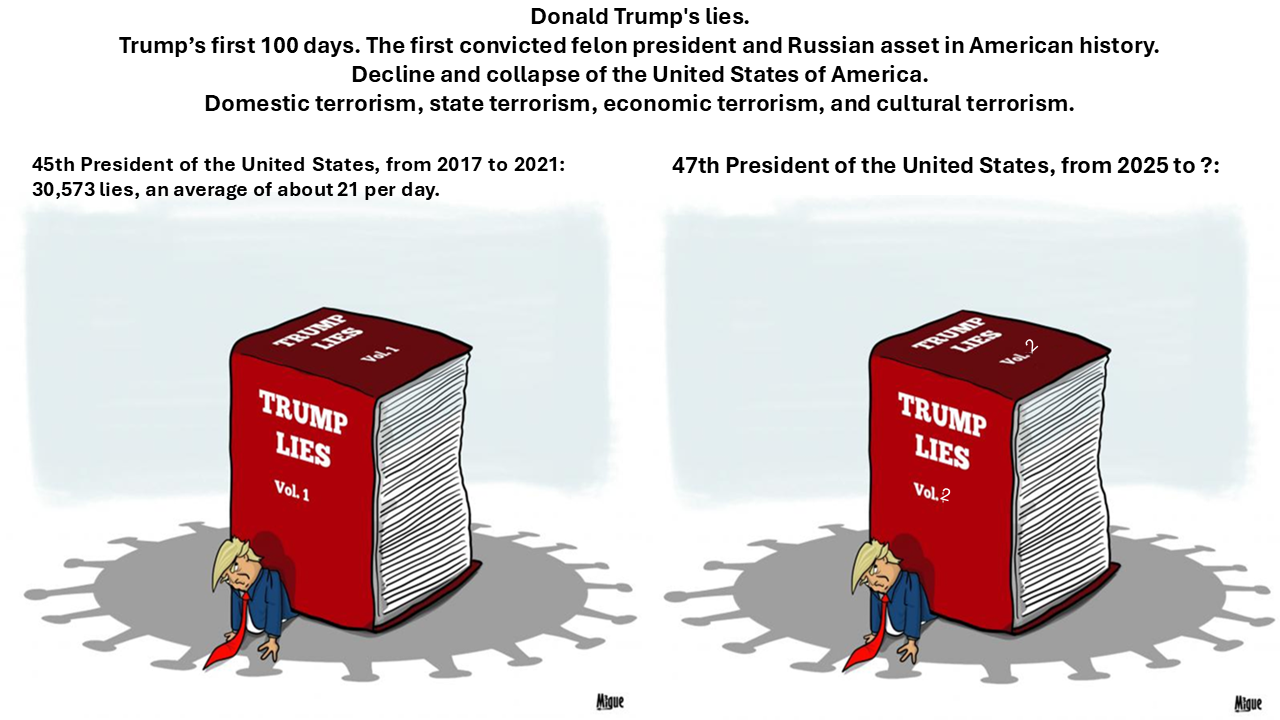
According to Grok, here are some examples:
POLITICIANS. TRUMP HAS MADE NUMEROUS THREATS AGAINST POLITICIANS, OFTEN ACCUSING THEM OF CORRUPTION, ELECTION INTERFERENCE, OR DISLOYALTY. THESE INCLUDE CALLS FOR INVESTIGATIONS, PROSECUTIONS, OR OTHER FORMS OF RETRIBUTION. IN SOME CASES, ACTIONS HAVE FOLLOWED, SUCH AS EXECUTIVE ORDERS OR LEGAL PRESSURES DURING HIS ADMINISTRATIONS.
Joe Biden. Trump has threatened Biden with FBI raids, investigations, indictments, and jail time over 25 times since 2023, often mirroring his own legal issues and accusing him of weaponizing the DOJ. He has also reposted violent threats against Biden, including calls for impeachment and handcuffing.
Kamala Harris. Trump has vowed to investigate and prosecute Harris for what he calls the “biggest crime story of our time” related to border issues, labeling her actions as criminal during campaign rallies.
Barack Obama. Trump has called for investigations into Obama as a political rival and former intelligence official, including threats of prosecution for unspecified crimes.
Hillary Clinton. Donald Trump has made multiple statements over the years that have been widely interpreted as threats against Hillary Clinton, ranging from calls for her prosecution and imprisonment to veiled suggestions of violence. These incidents span his 2016 presidential campaign, his time in office, and his post-presidency period. While Trump and his supporters have often dismissed such remarks as rhetorical or non-literal, critics—including legal experts, political opponents, and media outlets—have characterized them as dangerous, authoritarian, and potentially inciting.
Gavin Newsom. Donald Trump has made statements that could be interpreted as threats against California Governor Gavin Newsom. In June 2025, amid tensions over protests in Los Angeles related to immigration enforcement, Trump publicly endorsed the idea of arresting Newsom. When asked by reporters if his border czar, Tom Homan, should arrest Newsom, Trump responded, “I would do it if I were Tom. I think it’s great. Gavin likes the publicity,” and called Newsom “grossly incompetent.” He later suggested Newsom’s “primary crime” was “running for governor because he’s done such a bad job.” These remarks were in response to Newsom’s criticism of Trump’s deployment of the National Guard to Los Angeles, which Newsom argued was unlawful and escalated tensions. Newsom described Trump’s comments as an “unmistakable step toward authoritarianism” and announced plans to sue the Trump administration over the National Guard’s federalization. Additionally, Trump has repeatedly used derogatory language, referring to Newsom as “Newscum” on social media platforms like Truth Social, accusing him of mismanaging California and vowing to “save” the state. These exchanges are part of a broader feud, with Newsom actively countering Trump through social media trolling and political maneuvers, such as threatening retaliatory redistricting in California to offset Republican efforts in Texas. While Trump’s statements about arrest have not led to legal action against Newsom, they have heightened political tensions between the two.
Liz Cheney. Trump has suggested Cheney should face a military tribunal and execution for treason, calling her a “war hawk” and threatening prosecution for her role in the Jan. 6 committee.
Susan Rice. Trump has publicly criticized and targeted Rice through statements and social media, which some might interpret as harassment. Trump accused Susan Rice, former National Security Adviser under President Obama, of potentially committing a crime related to the “unmasking” of Trump campaign officials in intelligence reports during the 2016 election transition. In a 2017 New York Times interview, he claimed without evidence that Rice’s actions were a “massive story” and suggested she might have broken the law. These claims were widely criticized as baseless. Trump’s criticisms of Rice often aligned with broader efforts to deflect from investigations into Russian interference in the 2016 election.
Jerome Powell. Donald Trump has repeatedly criticized and pressured Federal Reserve Chair Jerome Powell, primarily over monetary policy disagreements, particularly on interest rates. These actions have been characterized by some as harassment or threats. Trump has frequently targeted Powell with derogatory remarks, calling him names like “Too Late Powell,” “stupid,” “very dumb,” and “a major loser.” He has accused Powell of incompetence, particularly regarding the Federal Reserve’s $2.5 billion headquarters renovation, which Trump claimed was mismanaged and overbudget, inflating costs to $3.1 billion in some instances. Threats of Legal Action: On August 12, 2025, Trump posted on Truth Social that he was considering allowing a “major lawsuit” against Powell, citing the Fed’s renovation costs as evidence of Powell’s “gross incompetence.” White House Press Secretary Karoline Leavitt confirmed Trump was considering this lawsuit but provided no further details. Trump has repeatedly suggested firing Powell or forcing his resignation, despite legal constraints limiting presidential authority to remove Fed chairs except “for cause” (e.g., misconduct, not policy disagreements). In July 2025, Trump reportedly waved a draft letter to fire Powell during a meeting with House Republicans, though he later denied imminent plans to follow through. He also stated in April 2025 that Powell’s “termination cannot come fast enough” but backed off after market reactions.
Adam Schiff. Trump has threatened to prosecute Schiff for “treason” related to congressional investigations and labeled him part of the “enemy from within.”
Nancy Pelosi. Trump has called for Pelosi’s prosecution, targeted her legislative accomplishments (e.g., ordering the elimination of the Presidio Trust), and accused her of insider trading.
Mike Pence. Trump has threatened Pence with investigation and punishment for certifying the 2020 election, calling him disloyal and part of internal enemies.
Chris Christie. Trump has threatened to investigate Christie, a former ally turned critic, as part of broader retribution against Republicans who opposed him.
Marco Rubio. During the 2016 Republican presidential primaries, Trump employed harsh rhetoric against Rubio, famously nicknaming him “Little Marco” to undermine his campaign. A post on X from August 2025 notes that Trump had “more mean things to say” about Rubio (along with others like Ted Cruz and Jeb Bush) in the past.
Ron DeSantis. Trump and DeSantis have had a well-documented rivalry, particularly as DeSantis emerged as a potential 2024 presidential contender. Trump used derogatory nicknames like “Ron DeSanctimonious” [Meatball Ron, Ron DisHonest, Tiny D, Snow White’s Dwarf] and criticized DeSantis’s record, accusing him of disloyalty and labeling him a “RINO” (Republican in Name Only). In November 2022, Trump issued a warning to DeSantis, stating, “If he did run, I will tell you things about him that won’t be very flattering. I know more about him than anybody other than perhaps his wife.” This statement could be interpreted as a veiled political threat to damage DeSantis’s reputation if he challenged Trump’s 2024 bid. Trump’s attacks on DeSantis were notably policy-focused in 2023, targeting issues like Social Security and Medicare, where Trump accused DeSantis of wanting to “destroy” these programs based on his congressional voting record. These criticisms were strategic, aimed at undermining DeSantis’s appeal among Republican voters.
Senate Democrats. Trump has suggested FBI raids on their homes and indictments, using Sen. Bob Menendez as an example of broader Democratic corruption.
Democrats. Trump has posted that “Democrats are going to start getting indicted” in a second term, framing them as political enemies.
OFFICIALS. THIS CATEGORY INCLUDES GOVERNMENT OFFICIALS, PROSECUTORS, JUDGES, INTELLIGENCE OFFICERS, AND MILITARY LEADERS. TRUMP HAS OFTEN THREATENED THEM WITH FIRING, PROSECUTION, OR TREASON CHARGES, AND IN SOME CASES, HAS ACTED ON THESE THROUGH DISMISSALS OR INVESTIGATIONS DURING HIS PRESIDENCIES.
Jack Smith. As special counsel, Smith has been threatened with prosecution and jail for leading federal cases against Trump.
Robert Mueller. There is less direct evidence in the provided information of Trump personally harassing or threatening Robert Mueller, the former special counsel who investigated Russian interference in the 2016 election. However, a 2017 Politico article notes that Murdoch-owned outlets, including the WSJ’s editorial page, aligned with Trump’s narrative by attacking Mueller. The WSJ published an editorial calling for Mueller’s resignation and featured an op-ed suggesting Trump issue a blanket pardon in the Russia investigation, including for himself. These pieces tracked White House talking points, suggesting an indirect effort by Trump to undermine Mueller through aligned media. While the sources do not explicitly detail Trump making direct personal threats against Mueller, his broader pattern of attacking the Russia investigation as a “witch hunt” and dismissing Mueller’s probe as illegitimate could be interpreted as a form of harassment through public delegitimization. Additionally, posts from Trump allies, such as Mike Flynn’s 2025 X post calling for Mueller’s investigation to be revisited and labeling it a “fabricated lie” and part of a “coup,” indicate that Trump’s circle has continued to target Mueller’s credibility, potentially at Trump’s behest.
Mark Milley. Trump has accused the former Joint Chiefs chairman of treason (punishable by death) and threatened prosecution for actions during the 2020 transition.
John Brennan. Trump has threatened to prosecute the former CIA director as part of retaliation against intelligence officials critical of him.
James Clapper. Similar to Brennan, Trump has called for prosecution of the former Director of National Intelligence.
Andrew McCabe. Trump has repeatedly threatened the former FBI deputy director with prosecution and reposted calls for extradition if he flees.
Alvin Bragg. Trump has called for the Manhattan DA’s prosecution, accusing him of bias in the hush money case.
Letitia James. The New York AG has been threatened with prosecution for her civil fraud case against Trump.
Fani Willis. Trump has threatened the Fulton County DA with jail for her election interference case.
Juan Merchan. The judge in Trump’s hush money trial has been threatened with prosecution or punishment.
Arthur Engoron. Trump has called for prosecution of the judge in his civil fraud case.
James Comey. Fired as FBI director in 2017 for handling the Russia investigation; Trump later threatened further action.
Jeff Sessions. Fired as Attorney General in 2018 for recusing from the Russia probe; threatened publicly beforehand.
Sally Yates. Fired as acting AG in 2017 for refusing to defend the travel ban.
Preet Bharara. Fired as U.S. Attorney in 2017 after refusing to resign.
John Kelly. Threatened with investigation as former chief of staff for criticizing Trump.
Bill Barr. As former AG, threatened for disloyalty after stating no widespread election fraud.
John Bolton. Threatened as former national security advisor for his critical book.
Stephanie Grisham. Former press secretary threatened personally after publishing a critical book.
Alyssa Farah Griffin. Threatened as former communications director for speaking out.
Cassidy Hutchinson. Jan. 6 committee aide threatened for her testimony.
Erika McEntarfer. Donald Trump has harassed and threatened Erika McEntarfer, the former Commissioner of the Bureau of Labor Statistics (BLS), by publicly accusing her of “rigging” jobs data on Truth Social and announcing her firing. On August 1, 2025, following a BLS report showing weak July job growth (73,000 jobs added, with downward revisions of 258,000 for prior months), Trump posted that the numbers were “RIGGED” to “make the Republicans, and ME, look bad.” He claimed she manipulated figures for political purposes, including to boost Kamala Harris in the 2024 election, and directed his team to “fire this Biden Political Appointee, IMMEDIATELY.” McEntarfer, a career economist confirmed by a bipartisan Senate vote (86-8) in 2024, was replaced by her deputy. Former BLS commissioners, including Trump’s own appointee William Beach, called the firing “groundless” and a “dangerous precedent” that undermines data integrity. Economists noted revisions are routine, not evidence of bias. Baselessly accusing a nonpartisan official of fraud and terminating her publicly qualifies as harassment, with the firing posing a direct threat to her career.
Lisa Cook. Donald Trump has harassed and arguably threatened Lisa Cook, a Federal Reserve Board governor, by publicly accusing her of mortgage fraud on Truth Social and announcing her firing without legal authority. On August 20, 2025, Trump posted that Cook “must resign, now!!!” following allegations from his ally, Federal Housing Finance Agency Director Bill Pulte, that she falsified documents for favorable loan terms. On August 25, 2025, Trump escalated by posting a termination letter on Truth Social, stating she was “hereby removed” effective immediately, citing Article II of the Constitution and the Federal Reserve Act. He detailed her alleged fraud, claiming she signed conflicting primary-residence documents for properties in Michigan and Georgia. Cook responded that Trump had “no authority” to fire her, vowing to sue and continue her duties, as governors can only be removed “for cause” under the Federal Reserve Act, and no charges have been filed against her. Critics, including Senator Elizabeth Warren, described this as an “illegal” and “authoritarian power grab” that undermines Fed independence. Publicly amplifying unproven fraud accusations and attempting an unlawful termination via social media constitutes harassment, and the threat to her position and reputation is evident given Trump’s influence.
Election workers and lawyers. Trump has threatened to prosecute those involved in 2020 election disputes, including firing defiant prosecutors.
EXECUTIVES AND BUSINESSPEOPLE. TRUMP HAS TARGETED BUSINESS LEADERS AND EXECUTIVES, PARTICULARLY IN TECH, WITH THREATS OF PROSECUTION, INVESTIGATIONS, OR REGULATORY ACTIONS, OFTEN FOR PERCEIVED BIAS OR CRITICISM.
George Soros. Donald Trump has repeatedly made public statements criticizing George Soros, often accusing him of funding protests, influencing elections, and undermining American society. These statements have escalated into direct threats, particularly in recent years. Trump has renewed calls for investigations and charges against Soros. Key instances of threats include: Recent Threat (August 27, 2025): Trump posted on Truth Social demanding that Soros and his son, Alex Soros, face federal racketeering (RICO) charges for allegedly supporting “violent protests” across the United States. He described them as “Radical Left lunatics” and warned, “We’re watching you—no more ripping apart our country.” During his 2024 presidential campaign, Trump vowed to “launch sweeping civil rights investigations” into “Marxist local District Attorneys” he claimed were backed by Soros, accusing them of “selective enforcement based on illegal racial discrimination.” He specifically targeted prosecutors like Manhattan DA Alvin Bragg, whom he falsely claimed was “hand-picked and funded by George Soros,” despite indirect and tenuous connections (Soros donated to a PAC that supported Bragg, but had no direct involvement). Trump also announced plans for a federal crackdown on “Soros investigators,” including one in Austin, Texas. Earlier Statements (2018–2020): Trump accused Soros of funding migrant caravans in 2018, calling them an “invasion” orchestrated by Soros. In 2020, amid Black Lives Matter protests following George Floyd’s death, Trump and his allies claimed Soros was paying protesters, a baseless conspiracy theory. These claims have been linked to increased threats against Soros, including pipe bombs sent to his home in 2018 by a Trump supporter. Critics argue this rhetoric endangers Soros and fuels violence.
Elon Musk. Donald Trump has threatened Elon Musk, primarily in the context of their public feud that escalated in 2025 over disagreements regarding Trump’s “One Big Beautiful Bill,” a significant tax and spending legislative package. The feud, detailed across multiple sources, centers on Musk’s vocal opposition to the bill due to its substantial increase in the U.S. debt ceiling and the elimination of electric vehicle (EV) subsidies, which directly impact Musk’s company, Tesla. Threats of Deportation and Financial Retribution: Trump suggested he might “take a look” at deporting Musk, a naturalized U.S. citizen born in South Africa, in response to Musk’s criticisms of the bill. This was reported by multiple outlets, including Bloomberg, The Independent, and The Guardian, with Trump stating, “I don’t know, we’ll have to take a look,” when asked about deporting Musk. He also threatened to cut billions in federal contracts and subsidies for Musk’s companies, SpaceX and Tesla, claiming that without these, Musk “would probably have to close up shop and head back home to South Africa.” Trump further suggested using the Department of Government Efficiency (DOGE), which Musk once co-led, against him, stating, “DOGE is the monster that might have to go back and eat Elon”. Musk’s Response: Musk escalated the feud by accusing Trump of lying about the EV mandate, suggesting Trump’s involvement in the Jeffrey Epstein files, and threatening to fund a new political party or primary challengers to Republicans supporting the bill. He briefly threatened to decommission SpaceX’s Dragon spacecraft, critical to NASA, but later retracted this statement. Context of the Feud: The conflict marks a shift from their previously close alliance, where Musk was a major donor to Trump’s 2024 campaign, spending over $250 million. The falling out began when Musk left his role at DOGE in May 2025 and intensified over the bill, which Musk labeled a “disgusting abomination” for adding $5 trillion to the debt ceiling. The threats appear to be rhetorical and aimed at political leverage, though they have raised concerns about targeting a U.S. citizen for political dissent, drawing comparisons to McCarthyism.
Jeff Bezos. During his first presidency, Trump repeatedly attacked Bezos, the founder of Amazon and owner of The Washington Post, over the newspaper’s critical coverage. He accused Bezos of using Amazon to avoid taxes and exploit the U.S. Postal Service, leading to threats against Amazon’s business deals. This included alleged interference that cost Amazon a $10 billion Pentagon cloud computing contract (JEDI) in 2019, which a court later suggested was influenced by Trump’s bias. Trump also mocked Bezos personally, calling him “Jeff Bozo.”
Mark Zuckerberg. Threatened with imprisonment over Facebook’s handling of his accounts post-Jan. 6; Meta settled a lawsuit for $25 million. Trump has accused Zuckerberg, the billionaire CEO of Meta, of election interference in 2020 by suppressing conservative content and donating to election infrastructure. In his 2024 book Save America, Trump threatened Zuckerberg with life in prison if he engaged in similar actions during future elections, stating, “We are watching him closely, and if he does anything illegal this time, he will spend the rest of his life in prison.” Trump reiterated threats to prosecute Zuckerberg and Meta for perceived biases.
Rupert Murdoch. Trump’s actions toward Rupert Murdoch, the media mogul and founder of News Corp (which owns the WSJ), also constitute harassment and threats. The $10 billion lawsuit names Murdoch personally as a defendant, an unusual move that legal analysts have described as a “gratuitous attempt to poke the bear.” Trump’s legal team further requested an expedited deposition of Murdoch, citing his advanced age (94) and health issues, which some interpret as an attempt to pressure or embarrass him. On Truth Social, Trump made inflammatory remarks, such as, “I look forward to getting Rupert Murdoch to testify in my lawsuit against him and his ‘pile of garbage’ newspaper, the WSJ. That will be an interesting experience!!!” These statements, combined with the lawsuit, indicate a personal and aggressive campaign against Murdoch. Despite their historically complex but often mutually beneficial relationship, this lawsuit marks a significant escalation, with Trump leveraging legal and public pressure to challenge Murdoch.
Sundar Pichai. As CEO of Alphabet (Google’s parent company), Pichai—a billionaire—has been indirectly targeted through Trump’s threats against Google. Trump accused the company of bias in search results, favoring negative stories about him, and vowed to direct the Department of Justice to prosecute Google “at the maximum levels” if re-elected. This stemmed from claims of election interference, though no evidence was provided. Google donated to Trump’s inauguration fund amid the tensions.
Google executives. Trump has threatened to prosecute Google for allegedly suppressing positive stories about him, calling for DOJ action.
Tech moguls. Broad threats to investigate and prosecute Silicon Valley leaders for election interference or bias.
Law firms (e.g., Perkins Coie, Paul Weiss). Targeted with executive orders revoking contracts, security clearances, and access to federal buildings for diversity policies or representing opponents; Paul Weiss capitulated with $40 million in pro bono services.
Nonprofits aiding immigrants. Threatened with prosecution for human trafficking and child smuggling.
MEDIA OUTLETS. TRUMP HAS FREQUENTLY ATTACKED MEDIA OUTLETS AS “FAKE NEWS” OR ENEMIES, THREATENING TO REVOKE LICENSES, SUE, OR PROSECUTE THEM. DURING HIS PRESIDENCIES, HE HAS ORDERED INVESTIGATIONS OR DEFUNDED RELATED ENTITIES.
The Wall Street Journal (WSJ). Donald Trump has engaged in actions that can be characterized as harassment or threats toward The Wall Street Journal (WSJ). In July 2025, Trump filed a $10 billion defamation lawsuit against the WSJ, its parent company Dow Jones, News Corp, Rupert Murdoch, News Corp CEO Robert Thomson, and two WSJ reporters, Khadeeja Safdar and Joe Palazzolo. The lawsuit was in response to a WSJ article claiming Trump sent a “bawdy” birthday letter to Jeffrey Epstein in 2003, which included a sexually suggestive drawing. Trump denied the authenticity of the letter, calling it “fake” and the WSJ a “useless rag.” He publicly threatened to sue the outlet on Truth Social, stating, “I’m going to sue his [Murdoch’s] ass off, and that of his third rate newspaper,” and expressed eagerness to have Murdoch testify in court. Additionally, Trump reportedly contacted Murdoch and WSJ editor-in-chief Emma Tucker directly before the article’s publication to warn them against running the story, claiming it was false. The lawsuit and public statements, including calling the WSJ a “pile of garbage,” are seen as attempts to intimidate the outlet. First Amendment experts have noted that a sitting president filing such a lawsuit against a news outlet is unprecedented and could be interpreted as an effort to silence critical reporting.
Fox News. Donald Trump has threatened and harassed Fox News and its journalists on multiple occasions, often in response to coverage he perceived as unfavorable. These incidents include public attacks, demands for firings, and incitements of online abuse, spanning his 2016 presidential campaign through his post-presidency.
CNN. Donald Trump has repeatedly targeted CNN with actions and rhetoric that have been interpreted as threats or persecution. The threats have been ongoing and have been ongoing for several years, with the most notable threats being those of 2017, 2018, and 2025.
ABC. Threatened to revoke broadcast licenses for critical coverage; targeted in 2025 for perceived bias.
NBC. Similar threats to revoke licenses and prosecute for “bad stories.”
CBS. Threatened with license revocation and legal action.
MSNBC. Accused of bias and threatened with investigations or shutdowns.
New York Times. Threatened with libel suits and prosecution for critical reporting.
Washington Post. Similar threats of suits and regulatory action.
The Atlantic. Donald Trump has harassed The Atlantic magazine through repeated public attacks on his Truth Social platform and in statements to reporters. These include calling the magazine a “failed” publication that “does very, very poorly” and claiming “nobody gives a damn about it.” He has also labeled its articles as “hoaxes,” denied knowledge of its reporting while dismissing it as irrelevant, and referred to its editor-in-chief, Jeffrey Goldberg, as a “total sleazebag.” These statements appear to stem from The Atlantic’s critical coverage of Trump, including stories about leaked war plans and other controversies. These repeated verbal assaults from a sitting president could reasonably be interpreted as harassment intended to discredit and intimidate the outlet.
Voice of America (VOA). Defunded and threatened for pro-democracy content, seen as a threat to free media abroad.
Smithsonian Institution. Issued executive order accusing it of “divisive ideology” and threatening funding cuts.
Journalists. Trump has personally attacked journalists, calling them “enemies of the people” and threatening arrests, surveillance, or violence. His administration has surveilled some, and he has encouraged violence at rallies. Trump has threatened over 100 times to prosecute or punish perceived critical journalists, including calls to shoot them at rallies; his administration surveilled several illegally. Donald Trump has had contentious interactions with journalists Jim Acosta (CNN) and Jorge Ramos (Univision), as well as others, which have been characterized by some as threats or persecution. Several other prominent journalists have faced similar treatment from Trump, characterized by teasing, harassment, bullying, verbal attacks, accusations of “fake news,” or restricted access: Lesley Stahl, April Ryan, Cecilia Vega, Kaitlan Collins, Megyn Kelly (Trump referred to her as a “bimbo” on social media, suggested she had “blood coming out of her wherever”, implying menstruation. In her 2016 memoir Settle for More, Kelly detailed how Trump’s actions led to a “year of guards and guns,” including death threats and online harassment from his supporters, which she attributed in part to Trump’s rhetoric and his social media director inciting abuse), Jennifer Griffin, Chris Wallace, Neil Cavuto, Serge Kovaleski (disabled New York Times reporter), Associated Press Journalist (2025), etc.
THE TRUMP ADMINISTRATION HAS TARGETED OR THREATENED SEVERAL UNIVERSITIES, PRIMARILY ELITE INSTITUTIONS, WITH ACTIONS SUCH AS FEDERAL FUNDING CUTS, INVESTIGATIONS, AND VISA RESTRICTIONS. THESE ACTIONS HAVE OFTEN BEEN JUSTIFIED BY CLAIMS OF ANTISEMITISM, IDEOLOGICAL BIAS, OR NON-COMPLIANCE WITH SPECIFIC POLICIES. BASED ON AVAILABLE INFORMATION, THE FOLLOWING UNIVERSITIES HAVE BEEN EXPLICITLY MENTIONED AS TARGETS.
Harvard University: Faced significant pressure, including a freeze of over $2.2 billion in federal grants, threats to revoke its tax-exempt status, and a six-month ban on foreign student visas, which was temporarily blocked by a federal judge. Harvard has been accused of allowing antisemitism and failing to comply with demands to overhaul admissions and disciplinary policies.
Columbia University: The first major institution targeted, with $400 million in federal grants canceled due to alleged failures to address antisemitism during pro-Palestinian protests. Columbia agreed to a $200 million fine and policy changes to restore funding, but faced further threats to its accreditation.
University of Pennsylvania: Targeted with a $175 million funding freeze due to an investigation into its athletics program, specifically related to transgender swimmer Lia Thomas, following an executive order barring transgender athletes from women’s sports. Penn made concessions, including modifying records and issuing an apology to female athletes.
Brown University: Had federal funding frozen, with a rumored $510 million cut, and reached a settlement involving a $50 million payout directed to state workforce development. The agreement included provisions to limit federal interference in academic matters.
Cornell University: Received over 75 stop-work orders for research, with an estimated $1 billion in federal funding at risk, linked to allegations of antisemitism and civil rights violations.
Northwestern University: Faced a funding freeze of approximately $790 million, despite cooperation with civil rights investigations, with no official White House notification provided.
Princeton University: Had federal funds frozen, though specific reasons and amounts remain unclear, with Princeton’s president criticizing the moves as threats to academic freedom.
Johns Hopkins University: Targeted with funding cuts by the U.S. Agency for International Development, leading to over 2,000 job eliminations.
University of California, Los Angeles (UCLA): Faced a funding pause of over $550 million, with a district judge ordering partial restoration. California officials described the action as an attempt to undermine academic freedom.
Other Universities: Over 60 universities, including Yale, Georgetown, Rice, Vanderbilt, New York University, University of Virginia, University of Michigan, and several University of California campuses (e.g., Berkeley, San Diego, Santa Barbara, Davis), have been under investigation for alleged antisemitic discrimination and harassment, with potential funding cuts threatened. These investigations often stem from pro-Palestinian protests or diversity, equity, and inclusion (DEI) policies.
The Trump administration’s actions have included freezing billions in research grants, threatening tax-exempt status, targeting DEI programs, and restricting international student visas, often citing antisemitism or ideological concerns. Many of these universities, particularly Ivy League schools, have been pressured to make concessions or face financial and legal repercussions. Some, like Harvard, have resisted through lawsuits, while others, like Columbia, have negotiated settlements.
These actions reflect a broader strategy to influence university policies, with critics arguing they threaten academic freedom and free speech. Note that the scope of investigations and threats has expanded to include both public and private institutions across the U.S., with 104 investigations reported by June 2025. However, specific details on all affected institutions or the full extent of actions may not be fully documented, as some universities have not received formal notifications of funding freezes.
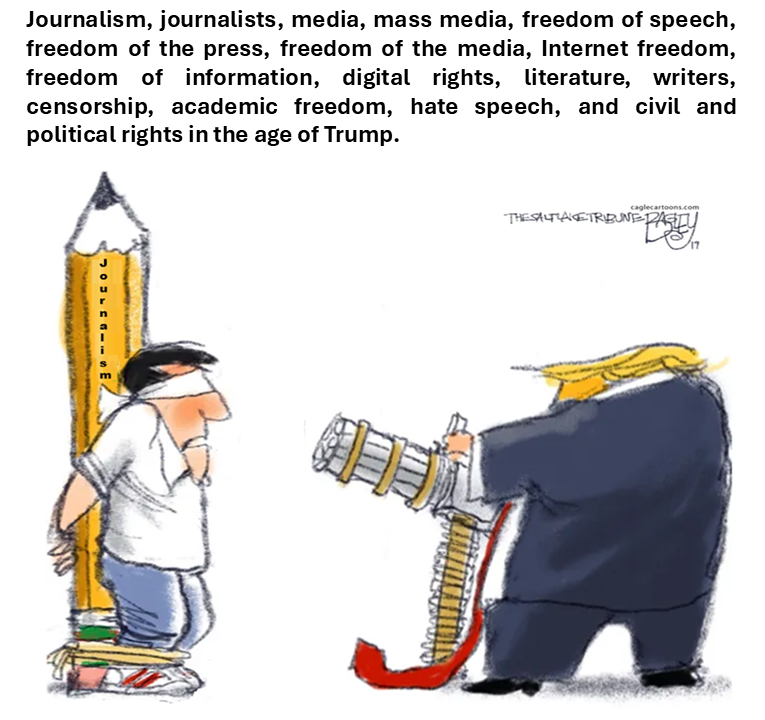
[…] Journalism, journalists, media, mass media, freedom of speech, freedom of the press, freedom of the media, Internet freedom, freedom of information, digital rights, literature, writers, censorship, academic freedom, hate speech, and civil and political rights in the age of Trump […]
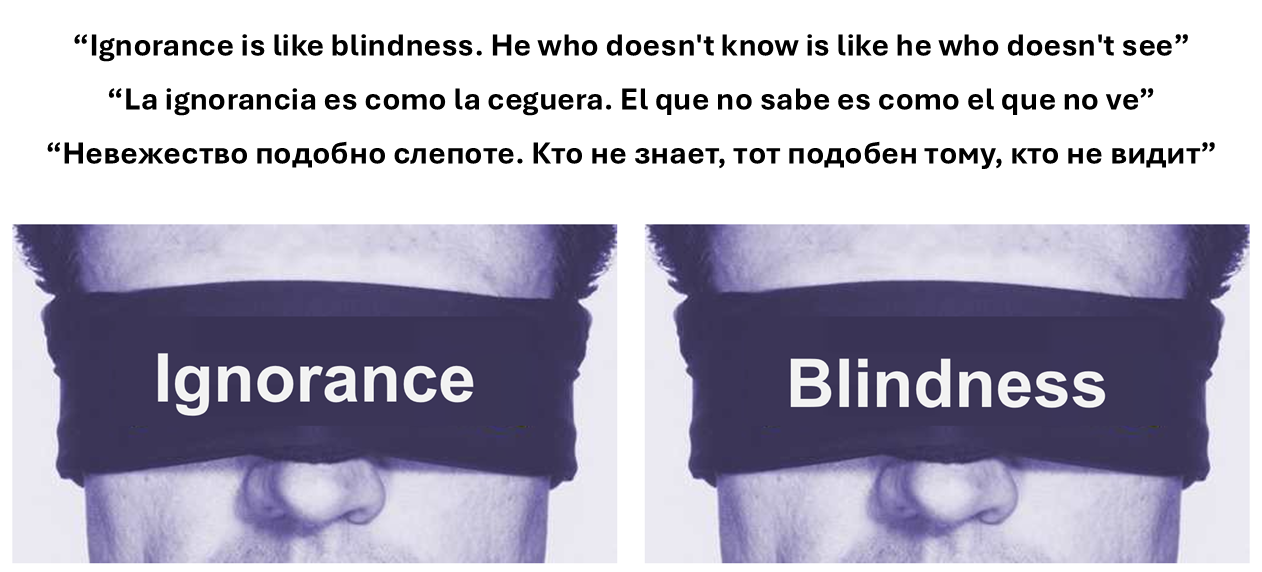
“Ignorance is like blindness. He who doesn’t know is like he who doesn’t see”
“La ignorancia es como la ceguera. El que no sabe es como el que no ve”
“Невежество подобно слепоте. Кто не знает, тот подобен тому, кто не видит”
One idiot or stupid is one idiot or stupid. Two idiots or stupid are two idiots or stupid. Ten thousand idiots or stupid are a political party.
Un idiota o estúpido es un idiota o estúpido. Dos idiotas o estúpidos son dos idiotas o estúpidos. Diez mil idiotas o estúpidos son un partido político.
Один идиот или глупец — это один идиот или глупец. Два идиота или глупца — это два идиота или глупца. Десять тысяч идиотов или глупцов — это политическая партия.
 ruanofaxas
Leave a comment