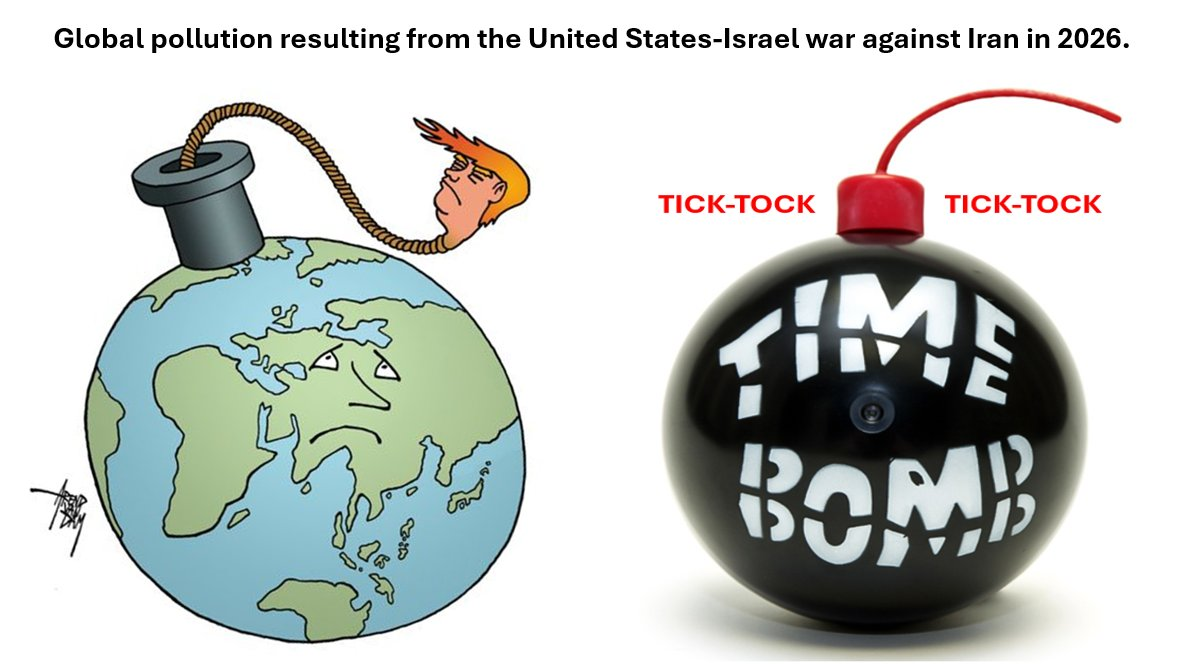
GLOBAL POLLUTION RESULTING FROM THE UNITED STATES-ISRAEL WAR AGAINST IRAN IN 2026.
CONTAMINACIÓN GLOBAL COMO RESULTADO DE LA GUERRA ENTRE ESTADOS UNIDOS E ISRAEL CONTRA IRÁN EN 2026.
ГЛОБАЛЬНОЕ ЗАГРЯЗНЕНИЕ ОКРУЖАЮЩЕЙ СРЕДЫ В РЕЗУЛЬТАТЕ ВОЙНЫ МЕЖДУ СОЕДИНЕННЫМИ ШТАТАМИ И ИЗРАИЛЕМ ПРОТИВ ИРАНА В 2026 ГОДУ.
The Economist @TheEconomist: “The Gulf war makes devastating oil spills more likely. It would also make them harder to handle. During the first Gulf war in 1991, Iraqi troops occupying Kuwait deliberately opened the taps of oil tankers, terminals and a refinery, releasing millions of barrels of crude into the Gulf. It was a last-ditch attempt to prevent American-led forces from making an amphibious landing. Saddam Hussein, #Iraq’s dictator, then ordered his troops to set hundreds of nearby oil wells alight. One American official said, ‘if Hell had a national park’, it would look like the inferno that resulted. It took international firefighters six months to extinguish the fires. More than 700km of Saudi coastline was coated in oil. The clean-up took decades and cost more than $500m (at the time) [$500 million in 1991 is equivalent to about $1.222 billion today]. Some ecological damage along the coast proved permanent.”
[…] The US-Israel military campaign against Iran began on February 28, 2026. As of today, May 29, 2026, the #UnitedStates–#Israel #war against #Iran has been going on for 3 months (that is to say 13 weeks or 91 days). The #pollution in the #PersianGulf has reached a catastrophic level, marked by massive oil spills covering dozens of square kilometers near Kharg Island, heavily contaminated marine habitats, and toxic runoff from damaged energy infrastructure. Because the Persian Gulf is a shallow, semi-enclosed basin, pollutants are trapped longer than they would be in open oceans. This poses long-term destruction to vital ecosystems, regional fisheries, and vital drinking water sources. Critical Oil Spills: Multiple strikes on Iranian oil facilities and maritime vessels have leaked millions of barrels of crude oil. Satellite data confirmed a massive spill stretching over dozens of square kilometers around Iran’s primary exporting hub at Kharg Island […] The pollution that outlives war. Long after fighting is over, the toxic leftovers of war continue to poison communities and the environment. War is measured first in lives lost, families uprooted and neighbourhoods reduced to rubble. But there are also deadly consequences that are often ignored. Pollution caused by war can settle over cities, contaminate water and soil, and shape public health long after the fighting is over. This is the case with the Iran war. The 3 months of bombardment in Iran and the Gulf that saw attacks on energy infrastructure have already taken a toll. Burning fuel tanks send toxic particles into the air, while debris, run-off and oil residues threaten coastal waters and marine ecosystems across the Gulf, where pollution can spread far beyond the immediate strike zone […] Local pollution in the Middle East is primarily driven by escalating armed conflicts, expanding fossil fuel industries, heavy urban vehicle emissions, and natural desert dust. While dust storms have historically been blamed for poor air quality, recent scientific studies reveal that over 90% of hazardous fine particulate matter (PM2.5) in the region is of anthropogenic (man-made) origin. The pollution landscape in the region has reached critical levels, directly reducing the average life expectancy of its residents […] The Middle East saw over 20 major interstate wars, civil wars, and regional campaigns in the 20th century (January 1, 1901-December 31, 2000). The Middle East saw over 12 major interstate wars, civil wars, and regional campaigns in the 21st century (January 1, 2001 to the present and up to January 1, 2001, to December 31, 2100) […] At this moment, the war that the United States and Israel have created against Iran has only one name: LARGE-SCALE GLOBAL DISASTER […] The production of regional military conflicts of all kinds, in the short term and in the very long term, has severely degraded the local environment, leaving a toxic footprint that threatens human health, agriculture, and water safety. Oil Refinery Fires & Toxic Rain: Military strikes on fuel infrastructure—such as the oil depot attacks around Tehran—have generated massive, persistent plumes of black smoke. This toxic soot mixes with precipitation, creating dangerous “black rain” and acid rain that contaminates soil and water systems. Desalination Risks: Marine targeting and oil tanker spills in the Persian Gulf threaten water desalination plants, which supply over 90% of the drinking water for roughly 100 million people in the Gulf. Chemical Legacies: The deployment of incendiary weapons like white phosphorus has ruined local vegetation. Additionally, recent studies highlight that wind-borne residues from heavy explosives have introduced long-lasting “forever chemicals” (PFAS) into regional soil and water wells, contaminating local crops […] PFAS stands for Per- and polyfluoroalkyl substances. They are a massive family of thousands of synthetic, man-made chemicals famously nicknamed “forever chemicals” because they do not easily break down in the environment or the human body. What Makes Them Unique? PFAS molecules are made of a chain of linked carbon and fluorine atoms. Because the carbon-fluorine bond is one of the strongest bonds in chemistry, these chemicals are incredibly stable and highly effective at resisting heat, water, oil, and stains […]
[…] The Middle East is in a state of chaos. Most Middle Eastern countries lack potable water and rely on desalination plants. Literally speaking, Donald Trump is destroying the Middle East; the cost is already terrible. Now we shall see how far “THE MIDDLE EAST’S REVENGE” or “ISLAMIC REVENGE” against the United States and the world will go […] There are 18 countries generally recognized as making up the Middle East. Of these, the vast majority (14 countries) suffer from severe water scarcity and lack sufficient natural potable water. Consequently, they rely heavily on seawater desalination plants. The region accounts for about 41.8% of the world’s total operational desalination capacity […] The UN has warned of a major ecological disaster as military strikes target oil facilities and ships, allowing petrochemical runoffs to mix directly into water treatment intakes. Because 90% of the Gulf’s water originates from just 56 heavily centralized plants, pollution combined with active military strikes threatens immediate societal collapse if systems fail […] Pollution in the Persian Gulf and Gulf of Oman from the 2026 US-Israel-Iran War. The 2026 conflict (which began around late February) involved strikes on energy infrastructure, oil facilities, ports, and some water-related sites, leading to oil spills, fires, potential chemical releases, and risks to desalination intakes […] The Persian Gulf is semi-enclosed with slow water circulation, making it highly vulnerable to pollution buildup (already stressed by prior desalination brine, oil activities, and hypersalinity) […] Fires releasing pollutants, potential tanker incidents in the Strait of Hormuz, and degraded water quality threatening marine ecosystems, fisheries, and brine dilution. Desalination plants themselves contribute to hypersalinity, and war pollution compounds this […] The six GCC states (Gulf Cooperation Council: Bahrain, Kuwait, Oman, Qatar, Saudi Arabia, United Arab Emirates or UAE) produce a large share (around 40% or more) of the world’s desalinated water via hundreds of plants and support over 60 million people […] Israel also relies significantly (~50% of potable water from coastal plants). Other countries like Jordan and Morocco are expanding desalination […] These plants are mostly along the Persian Gulf (and some Red Sea) coasts, using intakes that draw seawater and discharge brine. Many Gulf cities would face rapid shortages without them, as storage is often limited to days or a week in smaller states […] Key Countries and Dependence Levels: Qatar: ~99% of drinking water (61% of total water supply) from desalination. Nearly fully dependent. Kuwait: ~90% of drinking/residential water. Among the most vulnerable. Bahrain: ~59% of total supply (over 90% for drinking water); fully reliant on desalinated water for potable needs in recent years, with groundwater as backup. Oman: ~86% reliance. Saudi Arabia: ~70% of drinking water (world’s largest producer by volume; operates dozens of plants, including massive ones like Ras Al-Khair). UAE: ~42% overall, but higher (over 80% in some reports) for potable water in key areas; hosts major plants like Jebel Ali and Taweelah […]
#Trump #DonaldTrump #GOP #MAGA #Congress #MiddleEast #Hormuz #StraitOfHormuz #Oil #Gas #Gasoline #Terrorism #World


Leave a Reply